TenderKosh for EPC teams
Turn tender reading into faster bidding decisions.
Discover relevant tenders, monitor corrigenda, compare opportunities, and move from document reading to structured action.
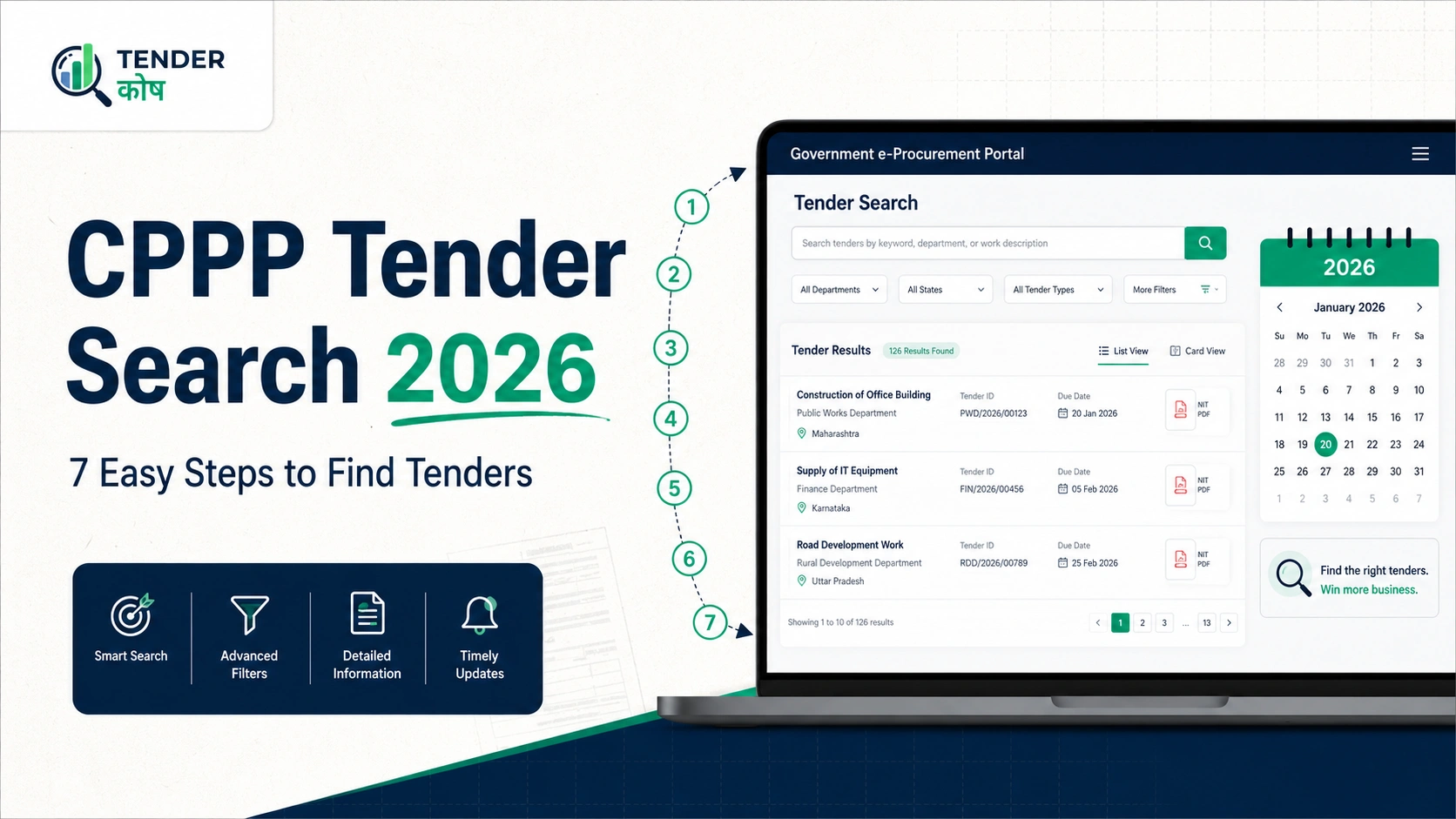
CPPP tender search happens at eprocure.gov.in — the Central Public Procurement Portal, built by NIC and operated under the Ministry of Finance. Under GFR 2017, central government tenders above a defined threshold must be published there, which makes it the most comprehensive single source of central tender notices in India.
The distinction that trips people up: publication and transaction are not the same thing. A tender published on CPPP may still be bid on the buying organisation’s own portal. Read the notice carefully before assuming where to submit.
If you sell to the Government of India, one web address does more work than any other. Central ministries, departments, public sector undertakings and autonomous bodies all publish their tender notices at eprocure.gov.in, which means a single search there surfaces opportunities from CPWD civil works to defence research contracts, medical equipment for hospitals and campus expansion at technical institutes.
The catch is that CPPP was built to publish tenders and receive bids, not to help you find the right ones. It has no alerting, no saved-search notifications, no history of who won what at what price. Search it badly and you drown; search it well and it becomes the backbone of your pipeline.
This guide covers what CPPP actually is, what you need before you can bid, a seven-step search workflow, how to track corrigenda, where CPPP sits alongside the other portals, and — honestly — what it cannot do for you.
Key Takeaways
The Central Public Procurement Portal is the Government of India’s e-procurement platform at eprocure.gov.in, developed and hosted by the National Informatics Centre and operated under the authority of the Ministry of Finance. Its purpose is transparency: bringing central procurement into a single public window.
It performs two functions that are constantly confused, and confusing them wastes bidders a great deal of time.
| Function | What It Means | Consequence for You |
|---|---|---|
| Publication | Central tenders above the GFR threshold must appear on CPPP to satisfy transparency requirements — regardless of where bidding happens | CPPP is the most complete discovery source for central tenders |
| Transaction | Many ministries and agencies also run their live bidding on CPPP — document download, bid upload, DSC signing, communications | For those tenders, CPPP is also where you submit |
Why this matters practically. Finding a tender on CPPP does not automatically mean you bid on CPPP. Some notices published there direct bidders to a departmental or PSU portal for submission — railways work often runs through IREPS, for example, and several PSUs operate their own e-procurement systems. Read the notice for the submission platform before you start preparing, not the day before the deadline.
You can browse and search CPPP without an account. You cannot download restricted documents or bid without one. Getting set up takes a few days, mostly because of the digital signature.
This is the workflow that turns thousands of live notices into the handful worth your time. Run it as a routine rather than an occasional trawl.
Type the address directly or use a bookmark. Search engines surface a great many lookalike domains and aggregator pages that carry incomplete or out-of-date listings.
Why it matters: a stale listing is worse than no listing — it tells you a tender is open when the window has closed.
The portal offers several ways in — searching tenders directly, browsing by organisation, browsing by classification, and an advanced search that combines conditions. Free-text keyword search alone is the least reliable route.
Why it matters: departments describe the same requirement in wildly different words. Category browsing catches what keywords miss.
Use tender category and classification to find work of your type. Then vary your keywords deliberately — a single item may appear as “supply of”, “procurement of”, “providing and fixing” or under a technical description you would never guess.
Why it matters: most bidders search one phrase, find little, and conclude there is no work. There usually is.
Restrict to the ministries, departments and PSUs you actually supply, and to the states or districts you can service. If you have delivered to an organisation before, watch it specifically — repeat requirements recur.
Why it matters: proximity and prior relationship are the two strongest predictors of a bid worth preparing.
Exclude tenders above your qualification ceiling, and those closing too soon to assemble a compliant bid. A tender closing in four days that needs a bank solvency certificate is not a real opportunity.
Why it matters: screening against pre-qualification criteria on day one saves the three weeks that go into an ineligible bid.
Download the full document set, read the eligibility clause first, and check the corrigendum listing against that tender reference before you invest any effort.
Why it matters: the eligibility you are assessing may already have been amended. Reading the original alone is reading an out-of-date document.
Log the tender reference, the organisation, the closing date and your eligibility position in a tracker. Then return to the tender page one final time immediately before upload.
Why it matters: amendments cluster near the deadline. The last check is the one that protects the bid.
The portal has no alerts, no saved searches and no cross-portal view. Track CPPP alongside GeM, IREPS, SECI, NTPC and state portals in one dashboard — filtered by category, value and location, with corrigendum alerts the moment a tender you follow changes.
The difference between a useful CPPP tender search and an overwhelming one is how aggressively you filter. Combine these rather than relying on any single one.
| Filter | Use It To | Practical Tip |
|---|---|---|
| Tender category / classification | Find work of your type regardless of wording | Start broad here, narrow with other filters |
| Organisation / ministry | Watch buyers you have supplied before | Build a shortlist of 10–15 and check them as a routine |
| Location / state | Exclude work you cannot service | Include neighbouring states if mobilisation is realistic |
| Tender value | Stay inside your qualification band | Set both a floor and a ceiling — tiny tenders waste as much time as oversized ones |
| Closing date | Filter out what you cannot prepare in time | Give yourself a realistic minimum — often two to three weeks |
| Keyword variations | Catch differently-worded notices | Keep a list of the phrasings used in your sector and rotate them |
Corrigenda are published against the tender, but nobody tells you they have arrived. Procuring organisations issue them frequently to extend deadlines, revise BOQ quantities, or amend qualification criteria — and each one changes the tender you are bidding against.
The practical routine: check the corrigendum listing when you first shortlist a tender, again mid-preparation, and once more immediately before you submit. If an amendment revises the BOQ, rebuild your pricing from the amended file rather than editing your earlier version — our guide on BOQ in tenders covers why modified BOQs get rejected. For how amendments work generally, see what a corrigendum in a tender is.
No single portal covers Indian public procurement, and using only one guarantees you miss work. Briefly, where each fits:
| Portal | What It Handles | Who Needs It |
|---|---|---|
| CPPP (eprocure.gov.in) | Central tender publication and, for many bodies, live bidding | Anyone selling to central ministries, departments or PSUs |
| GeM | Marketplace purchasing of catalogued goods and services, plus bids run on the platform | Suppliers of standard products and services |
| IREPS | Indian Railways works, stores, services and e-auctions | Railway contractors and vendors |
| State e-procurement portals | State department, DISCOM and municipal procurement | Anyone bidding below the central level |
| PSU own portals | Organisation-specific procurement, sometimes alongside CPPP publication | Sector suppliers — energy, defence, oil and gas |
CPPP is an important starting point for finding central government tenders, but it is not the only procurement channel you may need to monitor. Depending on your industry and target buyers, relevant opportunities may also appear on GeM, IREPS, PSU-specific e-procurement portals and state government tender portals. Always check the tender notice for the official submission platform and bidder requirements.
Being straightforward about this is more useful than pretending the portal is something it is not. CPPP is a publication and submission system built for transparency and compliance — not a business development tool.
For a firm bidding on two or three tenders a year, manual checking is entirely workable. For a firm running a pipeline, the arithmetic changes — and that is the gap aggregators exist to fill. Whichever route you take, the bid itself is still submitted on the official portal specified in the tender.
Search gets you to the tender. These habits get the bid accepted.
For the wider list of what causes bids to fail after submission, see our guide to tender bid rejection reasons.
CPPP is the Central Public Procurement Portal, the Government of India’s e-procurement platform, hosted at eprocure.gov.in. It is developed and maintained by the National Informatics Centre and operated under the authority of the Ministry of Finance. It is the point at which central ministries, departments, public sector undertakings and autonomous bodies publish their tender notices, corrigenda and award information.
The General Financial Rules 2017 require central government tenders above a defined value threshold — commonly cited as ₹25 lakh — to be published on CPPP for transparency. That makes CPPP the most comprehensive single source of central tender notices. It does not mean every tender is bid through CPPP, because a tender published there may be transacted on the buying organisation’s own portal.
Yes. Bidder enrolment on the e-procurement module of CPPP is free of charge. What does cost money is the Class III Digital Signature Certificate you need in order to bid, which is purchased from a certifying authority recognised by the Controller of Certifying Authorities, not from the portal.
A Class III digital signature certificate with signing key usage, issued by a certifying authority recognised by CCA India. After enrolling you register or map that DSC to your CPPP profile. Tender conditions commonly state that only one valid DSC should be registered by a bidder, so avoid mapping multiple certificates to the same account.
CPPP publishes corrigenda against the tender, but it is designed as a publication and submission system rather than a monitoring service. In practice bidders are expected to check the tender page themselves for amendments, which is why a missed corrigendum is such a common cause of rejection. Check the tender reference again immediately before you submit.
CPPP is a tendering platform where buyers publish notices and bidders submit competitive bids, typically for works, larger supplies and services. GeM is a marketplace where government buyers purchase catalogued goods and services directly, through comparison or through bids run on that platform. Many suppliers need presence on both, because the same organisation may buy routine items on GeM and tender larger requirements through CPPP.
Yes. Tender notices published on CPPP are in the public domain and can be browsed and searched without an account, which is what makes the portal useful for market research. Registration and a mapped Class III DSC become necessary when you want to download restricted documents, participate in a tender and submit a bid.
CPPP tender search rewards routine over effort. A weekly pass through a shortlist of organisations and categories, with hard filters on value and closing date, surfaces more usable work than an occasional deep trawl through everything.
Remember the two things the portal will not do for you: it will not tell you when something relevant appears, and it will not tell you when a tender you are already preparing has changed. Both are on you — and both are where bids are quietly lost. Build the checking habit, or automate it, but do not assume silence means nothing has moved.
Note: Portal features, search interfaces, registration steps and publication thresholds are set and revised by the operating authorities and may change without notice. Descriptions above reflect publicly documented behaviour of the Central Public Procurement Portal at the time of writing. Always follow the instructions in the individual tender document and on eprocure.gov.in itself, which prevail over any third-party description including this one.
This article is general information, not advice. It has been compiled from publicly available sources — government releases and notifications, official portals, published tender documents and trade reporting — and reflects our understanding at the time of writing. It is not legal, financial, tax or professional advice, and it does not create any advisory relationship.
Public procurement changes constantly. Tender terms, eligibility criteria, thresholds, fees, deadlines, scheme conditions and government policy are revised frequently, often through corrigenda issued mid-window and sometimes without wide notice. Figures and rules that were accurate when published may already have changed by the time you read this.
Always verify against the primary source before you act or bid. The tender document, the issuing authority's official portal and the relevant government notification are the authoritative sources. Where anything in this article differs from them, the official source prevails. Do not rely on this page — or on any third-party summary — as the basis for a bid, an investment or a compliance decision.
TenderKosh is a private tender-intelligence platform. We are not a government body, and we are not affiliated with, endorsed by or acting on behalf of any government department, ministry, PSU or procurement portal. Names, marks and portals referenced belong to their respective owners and are used for identification only. External links are provided for convenience; we do not control and are not responsible for third-party content.
While we take reasonable care, we make no warranty as to the accuracy, completeness or currency of this content, and accept no liability for any loss or damage arising from reliance on it.Spotted something wrong or out of date? Please tell us at support@tenderkosh.com — we correct errors promptly.See our full Disclaimer.
Discover relevant tenders, monitor corrigenda, compare opportunities, and move from document reading to structured action.