
TenderKosh for EPC teams
Turn tender reading into faster bidding decisions.
Discover relevant tenders, monitor corrigenda, compare opportunities, and move from document reading to structured action.
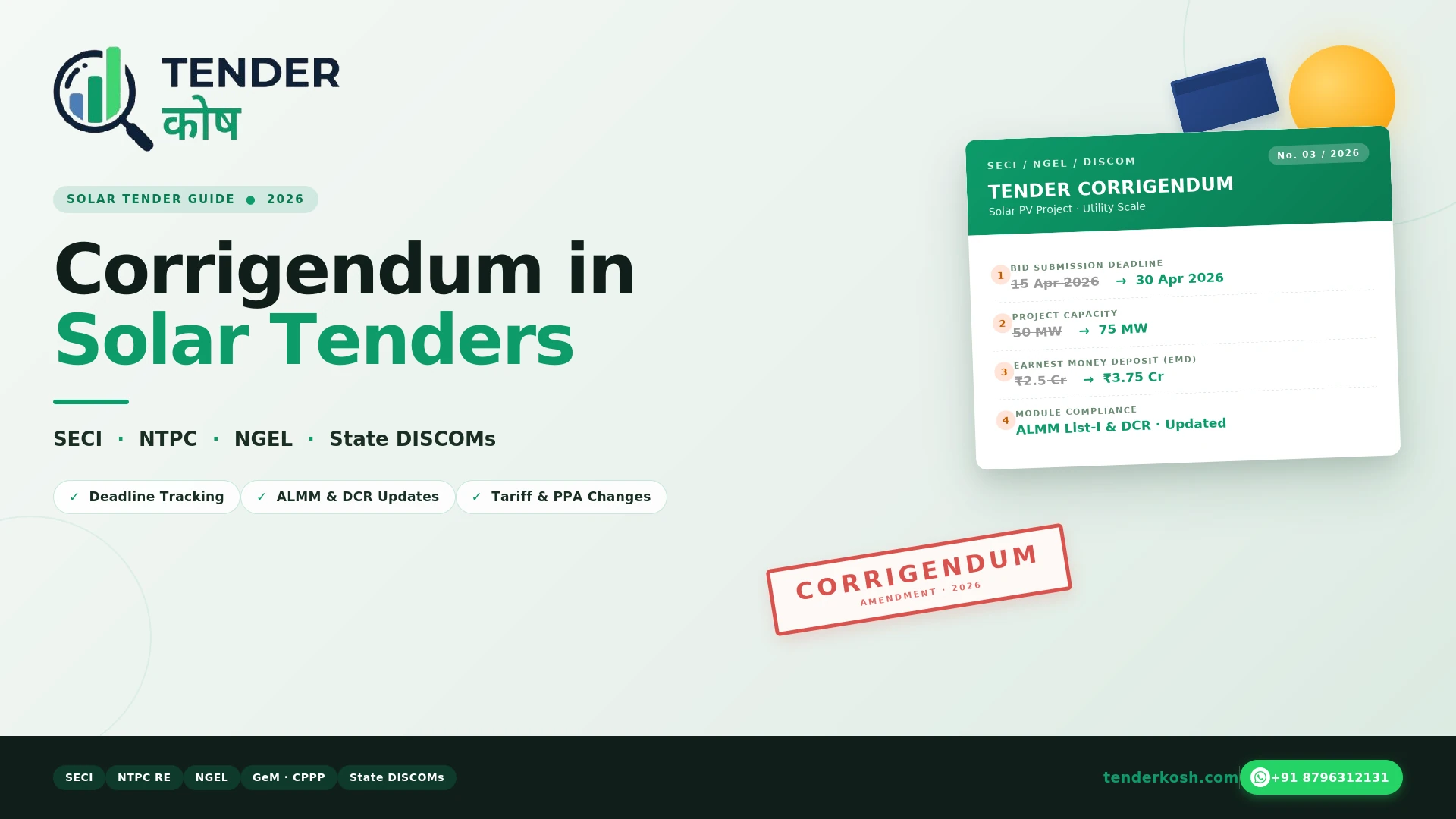
A corrigendum in solar tenders is a binding amendment to a tender that has already been published — and it is the single most common reason a technically strong bid gets rejected in India.
SECI, NTPC Green Energy, and state DISCOMs use a corrigendum in solar tenders to move deadlines, revise ALMM and technical specifications, change EMD and eligibility, and expand or shrink capacity. The latest amendment always overrides the original document, whether or not you saw it.
Solar tenders in India move fast, and the rules around them move faster. In any given week, SECI, NTPC Green Energy (NGEL), and a dozen state agencies publish a fresh corrigendum in solar tenders that changes bid dates, module requirements, turnover thresholds, or project scope. Miss one and a bid your team spent three weeks preparing can be rejected on a technicality it never had a chance to fix. Catch it in time and you sometimes get the opposite — a relaxed criterion, a longer window, or extra capacity that improves your odds.
This guide covers what a corrigendum in solar tenders actually is, why solar sees far more of them than other procurement categories, how each major issuing body publishes them, what to do in the first hour after one lands on a live bid, and how to stop tracking them by hand.
Key Takeaways
On this page
A corrigendum in solar tenders is an official amendment issued by the procuring agency to a tender that is already live in the market. It is used to correct errors, revise conditions, or shift timelines — and from the moment it is uploaded to the official portal, it becomes part of the tender document.
That last point is where bidders get hurt. A corrigendum in solar tenders overrides the original document on every clause it touches, and virtually every Indian tender places the burden of checking for amendments on the bidder, not the issuer. There is no requirement that you be personally notified. If you bid to the original specification after an amendment changed it, your bid is non-responsive, regardless of how competitive your price was.
The core rule: the latest published version governs. Before you upload anything, open the tender’s document page one final time and confirm you are bidding against the current set — not the PDF you downloaded three weeks ago.
For a general grounding on how amendments work across all categories of Indian public procurement, see our explainer on what a corrigendum in a tender is. This guide focuses specifically on how a corrigendum in solar tenders behaves in practice.
Solar sits at the intersection of policy, technology, and finance — and all three move quickly. A civil works tender for a road is written against specifications that were stable last year and will be stable next year. A solar RfS is written against a domestic-content list, a tariff environment, and a storage-technology assumption that can all shift inside the bid window itself. That is why a corrigendum in solar tenders is routine rather than exceptional.
Not every amendment carries the same risk. Knowing which type of corrigendum in solar tenders you are looking at tells you within a minute whether it needs a calendar update or a full re-run of your financial model.
The bid submission date moves out by 7, 15, or 30 days, usually with bid opening pushed correspondingly. Often triggered by low participation or a heavy volume of pre-bid queries.
Hidden cost: bid validity and EMD validity usually extend with it. If your bank guarantee expires against the old timeline, your bid is dead on a date nobody flagged.
Module wattage and efficiency bands, cell technology, the applicable ALMM list version, BESS round-trip efficiency, or PCS specifications get revised. In rooftop tenders, mounting-structure design and net-metering terms are frequent targets.
Hidden cost: your OEM compliance certificates may no longer match. Fresh datasheets and declarations take days to obtain — start immediately.
Turnover thresholds, net-worth requirements, similar-work experience, or EMD amounts are softened to widen the field — or tightened to filter it. Consortium and SPV shareholding conditions are amended here too.
Hidden cost: relaxations are opportunities. A tender you screened out in week one may now be one you qualify for, with a thin field.
Total tendered capacity, site list, or PPA tenure is modified. SECI rooftop tranches in particular see capacity revised after site assessment, and greenshoe provisions can expand award size at the discovered tariff.
Hidden cost: a capacity change alters your per-unit overhead recovery. Reprice rather than scaling your old number linearly.
After the pre-bid meeting, the agency publishes bidder queries with official replies. Where a reply changes a term, it is issued as a corrigendum rather than as minutes — and it is binding.
Hidden cost: teams skim these as “meeting notes”. Read the reply column line by line; real specification changes hide there.
Ceiling tariff, escalation, payment security mechanism, curtailment compensation, or liquidated damages provisions are amended.
Hidden cost: these hit project IRR directly. A curtailment clause rewrite can flip a viable project to unviable without changing a single technical parameter.
Track every corrigendum in solar tenders across SECI, NTPC Green Energy, GeM, CPPP, and state DISCOM portals in one dashboard — filtered by capacity, technology, and state, with alerts the moment something moves.
The Solar Energy Corporation of India is the country’s largest solar tender issuer, and in 2026 the principal implementing agency for new central renewable procurement. More tenders means more amendments — SECI’s utility-scale, hybrid, RTC, FDRE, BESS, and rooftop RESCO programmes each run their own bidding cycle, and each cycle produces its own stream of changes.
Where SECI publishes amendments:
A SECI corrigendum in solar tenders tends to cluster predictably. Expect one wave immediately after the pre-bid meeting, a second mid-window as clarifications settle, and a third within roughly 48 hours of the original submission date. Plan your document freeze around that third wave rather than the first — teams that lock everything down early are exactly the ones caught by a late change.
| SECI Programme | What Amendments Usually Change |
|---|---|
| Rooftop RESCO tranches | Capacity per institution after site survey, EMD restructuring, site additions and deletions, net-metering terms |
| VGF and PSU scheme tenders | DCR module compliance, ALMM List-II cell sourcing rules, commissioning milestones |
| RTC / FDRE auctions | Storage configuration, dispatch profile, availability obligations, curtailment terms |
| Utility-scale ISTS | Ceiling tariff, connectivity timelines, greenshoe capacity, bid validity |
| Module & equipment supply | Package sizing, EMD per package, DCR proof requirements, delivery schedule |
For the wider picture of what SECI is tendering this year and how its bid process runs end to end, see our guide to SECI solar tenders 2026.
NTPC runs its renewable business through NTPC Green Energy Limited (NGEL), which tenders continuously across solar PV, BESS, hybrid projects, green hydrogen infrastructure, and O&M. Its documentation style differs from SECI’s, and so does the shape of a typical corrigendum in solar tenders it issues.
Where NTPC and NGEL publish amendments:
NGEL solar tenders typically use a two-envelope structure, with the technical bid in envelope one and the price bid in envelope two — if that split is unfamiliar, our guide on technical bid vs financial bid covers how each is evaluated. Amendments most often land on the qualification side rather than the technical side: eligibility routes added or withdrawn, EPC experience thresholds, annual turnover and net worth, EMD amount and validity, and the pre-bid query and bid-opening calendar.
Watch the local-content classification. A corrigendum in solar tenders that revises Class-I and Class-II local supplier definitions under Make in India provisions can change who is eligible without touching a single technical parameter — and it is easy to skim past, because it reads like boilerplate.
State DISCOMs and nodal agencies issue some of the largest solar volumes in the country — and they are by far the hardest to track. Each state runs its own portal, its own document naming convention, and its own alert system, most of which are unreliable.
| State / Agency | What They Tender | Where Amendments Appear |
|---|---|---|
| GUVNL (Gujarat) | Utility-scale solar, hybrid, BESS | GUVNL tender section, state e-procurement portal |
| RUMSL (Madhya Pradesh) | Solar parks and mega projects (Rewa, Agar, Neemuch) | rumsl.mp.gov.in, MPPGCL e-tender portal |
| MSEDCL (Maharashtra) | Agri-feeder solar (Saur Krishi Vahini), DISCOM PPAs | mahatenders.gov.in, MSEDCL portal |
| RREC / RVUNL (Rajasthan) | Solar parks, RVUNL PPAs | energy.rajasthan.gov.in, sppp.rajasthan.gov.in |
| TANGEDCO (Tamil Nadu) | Utility solar, group captive, hybrid | TANGEDCO portal, tntenders.gov.in |
| UPNEDA (Uttar Pradesh) | Rooftop, PM-KUSUM Component-C, agri solar | upneda.org.in, etender.up.nic.in |
| KREDL (Karnataka) | Solar parks, KUSUM, rooftop RESCO | kredl.karnataka.gov.in, eproc.karnataka.gov.in |
| NREDCAP / APGENCO (Andhra Pradesh) | Utility solar, KUSUM-A and KUSUM-C | nredcap.in, apeprocurement.gov.in |
| HAREDA / HVPNL (Haryana) | Rooftop, PM-KUSUM, DISCOM PPAs | etenders.hry.nic.in, hareda.gov.in |
The most common state-level mistake: registering on one portal when the project touches three. A single Tamil Nadu solar park can have a corrigendum in solar tenders land on the TANGEDCO site, the state e-procurement portal, or CPPP — and there is no guarantee it appears on all three at the same time, or at all. Check every channel the tender references.
Amendments are not evenly distributed across the bid window — they cluster at four predictable points. Structuring your internal review around those points is cheaper than checking daily and far more reliable than checking weekly.
| Stage | What Typically Changes | Your Action |
|---|---|---|
| Week 1 after publication | Clerical corrections, annexure replacements, portal or document-set fixes | Re-download the full document set before starting work |
| Immediately post pre-bid | Clarifications formalised; specification and eligibility changes | Full re-screen of eligibility and technical compliance |
| Mid-window | Capacity, scope, tariff cap, EMD revisions | Re-run the financial model; reconfirm EMD instrument |
| Final 48 hours | Deadline extension, or a last technical clarification | Final check before upload — every time, without exception |
Amendments create urgency, and the team that responds fastest usually keeps the most optionality. Work this sequence the day a corrigendum in solar tenders lands on a bid you are pursuing.
The manual method works, and it costs a serious bidder eight to twelve hours a week. Register on every relevant portal — SECI, NGEL, NTPC eProcure, CPPP, GeM, and each state portal you bid into. Configure email alerts wherever they exist. Then check each portal by hand every 24 to 48 hours through every live bid window. It is reliable in principle and leaky in practice, because portal alerts fail silently and nobody notices until a bid is rejected.
The alternative is an aggregator that watches every portal continuously, normalises the amendment data, and notifies you when something changes on a tender you are following. If you are evaluating one, the criteria that matter are coverage of every issuing body you bid into, alerts measured in minutes rather than next-day digests, change highlighting that tells you what moved rather than just “tender updated”, full document version history so you can compare old against new, and solar-specific filters by capacity, technology, state, and delivery mode.
That is the problem TenderKosh is built around — complete coverage across SECI, NGEL, NTPC, GeM, CPPP, and state DISCOM portals, so every corrigendum in solar tenders you care about reaches you the day it publishes. You still submit on the official portal; the tracking is what gets automated.
A corrigendum in solar tenders is an official amendment to an already-published tender. It is used to extend deadlines, revise technical specifications such as ALMM or module requirements, change eligibility or EMD, alter capacity and scope, or formalise pre-bid clarifications. Once published on the official portal it is legally binding and overrides the original tender on every point it touches.
There is no legal cap. Large SECI and NTPC Green Energy tenders frequently receive five to ten amendments during a single bid window, while smaller state DISCOM tenders usually see one to three. The count is not the risk — missing any one of them is.
Yes. Once published on the official portal, a corrigendum in solar tenders becomes part of the tender document. Bidders are expected to track and comply with every amendment regardless of whether an email alert was received, and most tender documents state this explicitly.
Objections can be raised during the pre-bid clarification window or through formal representation to the issuing agency, which is by far the most practical route. In rare cases where an amendment is argued to conflict with published bidding guidelines, bidders have pursued remedies before the appropriate regulatory commission or a High Court. This is a general description of practice, not legal advice — take counsel on any specific dispute.
A corrigendum corrects or modifies terms that already exist in the tender, while an addendum adds new information without changing what was published. In Indian procurement practice the two words are often used interchangeably, so treat any document labelled either way as a binding change.
Often. If the bid submission date is extended, bid validity usually extends with it and the EMD instrument must be revalidated to match. A corrigendum in solar tenders can also revise the EMD amount itself. Re-read the EMD and PBG clauses after every amendment and reissue the bank guarantee where required.
Register on the state e-procurement portal, the DISCOM or nodal agency website, and CPPP, because the same project’s amendments can appear on any of the three. A tender aggregator that monitors all of them simultaneously and alerts on change is the practical alternative to checking each portal by hand every day.
In Indian solar procurement, a corrigendum in solar tenders is where good bids quietly die. Not on price, not on capability, but on a specification that changed in week three and a team still working from the week-one PDF.
Treat every amendment as a live document, not an administrative footnote. Know which of the six types you are looking at, run the response checklist the day it lands, and build a final portal check into your submission ritual. Do that consistently and the constant churn of solar procurement stops being a risk and starts being an edge — because most of your competitors are not doing it.
Note: Portal addresses, agency structures, and programme details referenced above reflect public information current at the time of writing and can change. Always confirm a tender’s live status, document set, and deadline on the relevant official portal — seci.co.in for SECI, the NTPC and NGEL portals for NTPC Green Energy, and the applicable state e-procurement portal for DISCOM tenders — before acting.
This article is general information, not advice. It has been compiled from publicly available sources — government releases and notifications, official portals, published tender documents and trade reporting — and reflects our understanding at the time of writing. It is not legal, financial, tax or professional advice, and it does not create any advisory relationship.
Public procurement changes constantly. Tender terms, eligibility criteria, thresholds, fees, deadlines, scheme conditions and government policy are revised frequently, often through corrigenda issued mid-window and sometimes without wide notice. Figures and rules that were accurate when published may already have changed by the time you read this.
Always verify against the primary source before you act or bid. The tender document, the issuing authority's official portal and the relevant government notification are the authoritative sources. Where anything in this article differs from them, the official source prevails. Do not rely on this page — or on any third-party summary — as the basis for a bid, an investment or a compliance decision.
TenderKosh is a private tender-intelligence platform. We are not a government body, and we are not affiliated with, endorsed by or acting on behalf of any government department, ministry, PSU or procurement portal. Names, marks and portals referenced belong to their respective owners and are used for identification only. External links are provided for convenience; we do not control and are not responsible for third-party content.
While we take reasonable care, we make no warranty as to the accuracy, completeness or currency of this content, and accept no liability for any loss or damage arising from reliance on it.Spotted something wrong or out of date? Please tell us at support@tenderkosh.com — we correct errors promptly.See our full Disclaimer.
Discover relevant tenders, monitor corrigenda, compare opportunities, and move from document reading to structured action.