TenderKosh for EPC teams
Turn tender reading into faster bidding decisions.
Discover relevant tenders, monitor corrigenda, compare opportunities, and move from document reading to structured action.
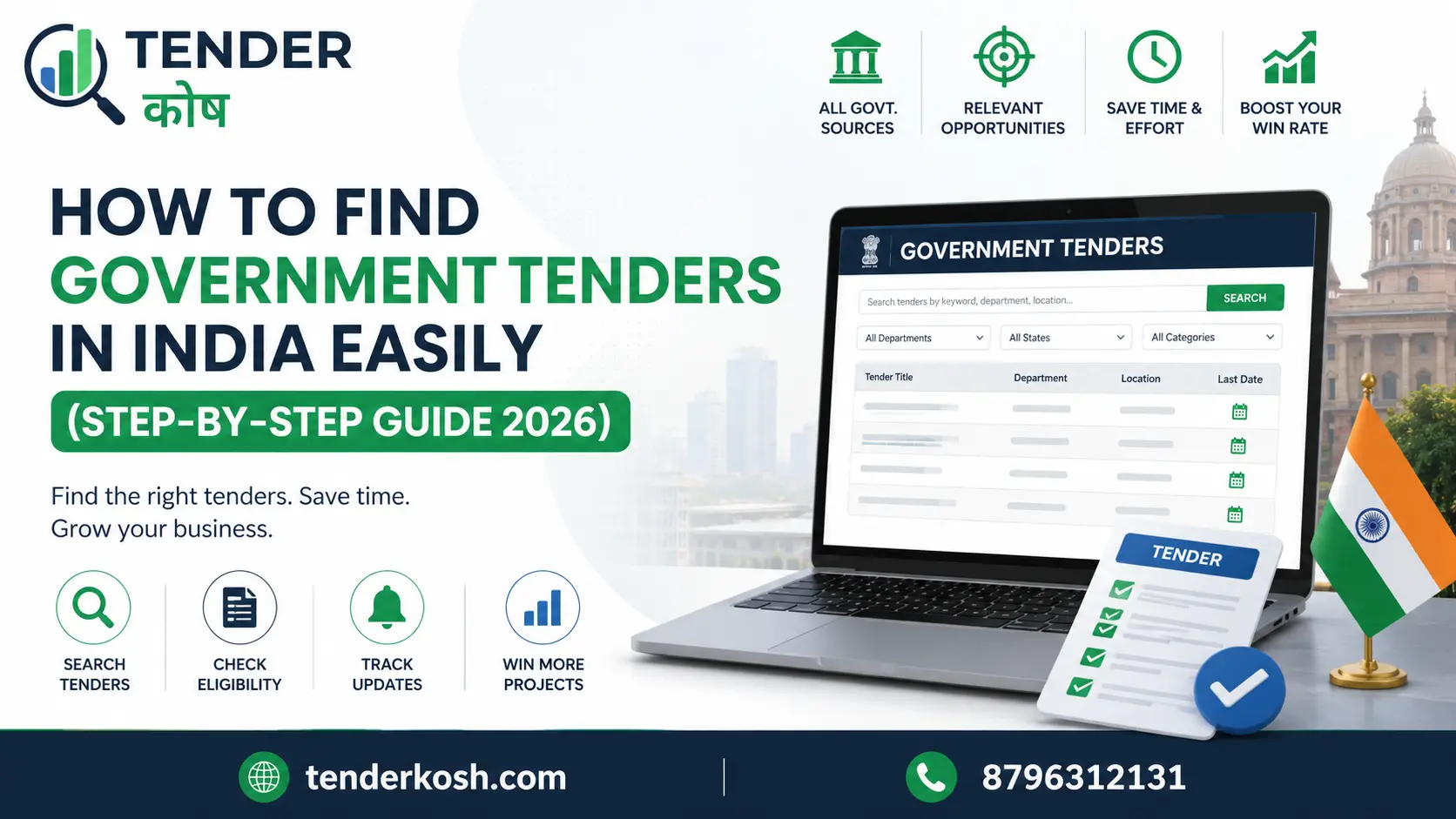
Government tenders in India are published across dozens of central, state, and PSU procurement portals. For contractors, MSMEs, suppliers, and EPC firms, the challenge is not the shortage of opportunities — it is finding the right tenders before deadlines close, without manually checking every portal every day.
This guide covers where government tenders are published in India, how to search for relevant opportunities, what the bidding process involves, and how to avoid the most common mistakes that cost businesses orders they were qualified to win.
Key Takeaways
India does not have a single national tender portal. Procurement is decentralised across central government departments, state governments, PSUs, and sector bodies — each maintaining its own portal. The major sources are listed below.
| Portal / Source | What It Covers | Who Should Track It |
|---|---|---|
| CPPP — eprocure.gov.in | Central government ministries, departments, and attached offices | All sectors — civil, IT, supply, services, consultancy |
| GeM — gem.gov.in | Direct purchase and custom bids from central and state government buyers | Product suppliers, OEMs, resellers, service providers |
| SECI — seci.co.in | Solar, wind, and renewable energy EPC tenders | Solar EPC contractors, equipment suppliers, O&M firms |
| NTPC — ntpctender.com | Power sector — thermal, hydro, solar, and services | EPC contractors, O&M firms, equipment suppliers |
| Indian Railways — ireps.gov.in | Railway civil, electrical, signalling, manufacturing, and supply tenders | Railway contractors, component manufacturers, service firms |
| CPWD — cpwd.gov.in | Central public works — buildings, roads, electrical, horticulture | Civil contractors, electrical contractors, architects |
| State e-Procurement Portals | State government works, supply, and service contracts | State-level contractors and suppliers in respective states |
| PSU Portals — IOCL, ONGC, BHEL, HPCL | Oil, gas, infrastructure, heavy engineering tenders | Industrial suppliers, EPC firms, maintenance contractors |
The problem: Each portal has a different login, search interface, and notification system. A business targeting solar EPC, civil, and GeM supply simultaneously needs to monitor 6 to 10 portals daily — or use a platform that aggregates them.
The process from finding a tender to submitting a bid follows a defined sequence. Understanding each step reduces the risk of missing deadlines or submitting incomplete bids.
Understanding the tender type before bidding helps businesses prepare the right documents and price the bid correctly.
Any eligible business can participate. Most common type — published on CPPP, GeM, and PSU portals. No pre-qualification required unless stated in the TQC.
Invited to a shortlist of pre-approved or pre-registered vendors only. Common in defence, sensitive infrastructure, and repeat-work contracts.
Expression of Interest (EoI) or Request for Qualification (RfQ) issued first. Shortlisted firms are then invited to submit full technical and financial bids.
Government buyers on GeM post requirements directly. Sellers respond through the GeM portal. Requires active GeM seller profile, correct category mapping, and in many cases a Vendor Assessment certificate.
Fixed rates established for a period — typically 1 to 3 years. Buyers draw from the rate contract as needed. Common in supply, maintenance, and consumable categories.
Engineering, Procurement, and Construction contracts where a single firm is responsible for design, supply, and commissioning. High value — strict TQC including experience, net worth, and technical manpower criteria.
Government tenders in India are open to a wide range of businesses — but eligibility depends on the specific tender’s qualifying criteria, not on company size alone.
| Business Type | Can Bid? | Key Requirements |
|---|---|---|
| Micro and Small Enterprises (MSEs) | Yes — with additional benefits | Udyam Registration, possible EMD exemption, price preference in eligible tenders. See MSME tender benefits. |
| Medium Enterprises | Yes | Udyam Registration, standard eligibility criteria as per tender TQC. |
| Large Companies / Corporates | Yes | Standard TQC — turnover, experience, certifications. No MSME procurement preferences. |
| OEMs and Manufacturers | Yes | Product-specific certifications (BIS, ISO), GeM Vendor Assessment for GeM tenders. |
| Resellers and Traders | Yes — with OEM authorisation | Valid OEM authorisation letter covering the tendered product category and submission date. |
| Consortiums / JVs | Yes — where permitted | Joint Bidding Agreement, lead member criteria, member-wise eligibility as defined in TQC. |
Most businesses lose tenders not because they were unqualified — but because of avoidable process errors at the search and submission stage.
| Mistake | Impact | How to Avoid |
|---|---|---|
| Monitoring only one portal | Missing the majority of relevant tenders published on other platforms | Track sector-specific portals alongside CPPP and GeM. Use an aggregator platform to reduce manual effort. |
| Bidding without reading the full tender document | Submitting wrong documents, missing mandatory certificates, or pricing a BOQ incorrectly | Always download and read the complete tender document — not just the NIT summary — before preparing a bid. |
| Missing corrigenda after downloading the tender | Bid prepared against outdated eligibility or EMD conditions — evaluated against the amended version | Check the portal for amendments every 2–3 days until the submission deadline. |
| Submitting at the last minute | Portal slowdowns or file size errors cause missed submissions — portals do not accept late uploads | Complete and upload bid documents at least 24 hours before the deadline. |
| Not verifying MSME benefit applicability per tender | Assuming EMD exemption applies when the specific tender requires it from all bidders | Read the EMD clause in each tender individually. Do not assume benefit applicability from previous tenders. |
TenderKosh aggregates live tenders from GeM, CPPP, SECI, NTPC, Railways, CPWD, IOCL, and 100+ government procurement portals — with corrigendum monitoring, keyword search, and sector-wise filtering in one place.
Find Live Tenders View PlansGovernment tenders in India are published across multiple platforms — CPPP (eprocure.gov.in) for central government, GeM (gem.gov.in) for goods and services, state e-procurement portals for state government works, and sector-specific portals like SECI, NTPC, IREPS (Railways), and individual PSU portals. No single portal covers all tenders.
Start by identifying your business category — whether you are a contractor, supplier, manufacturer, or service provider — and the sectors your experience and registrations qualify you for. Then search using specific product names, work types, or department names on the relevant portals. Platforms like TenderKosh allow keyword and sector-wise search across 100+ portals from one place.
Yes. Registered Micro and Small Enterprises (MSEs) with valid Udyam Registration are eligible for EMD exemption, tender document fee waiver, price preference (L1 + 15% band matching), and access to reserved item procurement — where the specific tender permits these benefits. See the full guide on MSME benefits in government tenders.
Standard documents include: GST registration, PAN, company registration certificate, Udyam certificate (for MSMEs), audited financial statements for the last 3 years, similar work experience proof (work orders + client completion certificates), quality certifications (ISO, BIS where applicable), and EMD or bid security declaration. The exact requirements vary per tender — always check the TQC clause in the tender document.
CPPP (Central Public Procurement Portal) is a notice board for government tenders — it publishes Notice Inviting Tender (NIT) documents for civil works, services, supply contracts, and consultancy. Actual bid submission happens on the department’s own e-portal. GeM (Government e-Marketplace) is a transactional platform where government buyers directly purchase goods and services from registered sellers through catalogue listings or custom bids.
This article is general information, not advice. It has been compiled from publicly available sources — government releases and notifications, official portals, published tender documents and trade reporting — and reflects our understanding at the time of writing. It is not legal, financial, tax or professional advice, and it does not create any advisory relationship.
Public procurement changes constantly. Tender terms, eligibility criteria, thresholds, fees, deadlines, scheme conditions and government policy are revised frequently, often through corrigenda issued mid-window and sometimes without wide notice. Figures and rules that were accurate when published may already have changed by the time you read this.
Always verify against the primary source before you act or bid. The tender document, the issuing authority's official portal and the relevant government notification are the authoritative sources. Where anything in this article differs from them, the official source prevails. Do not rely on this page — or on any third-party summary — as the basis for a bid, an investment or a compliance decision.
TenderKosh is a private tender-intelligence platform. We are not a government body, and we are not affiliated with, endorsed by or acting on behalf of any government department, ministry, PSU or procurement portal. Names, marks and portals referenced belong to their respective owners and are used for identification only. External links are provided for convenience; we do not control and are not responsible for third-party content.
While we take reasonable care, we make no warranty as to the accuracy, completeness or currency of this content, and accept no liability for any loss or damage arising from reliance on it.Spotted something wrong or out of date? Please tell us at support@tenderkosh.com — we correct errors promptly.See our full Disclaimer.
Discover relevant tenders, monitor corrigenda, compare opportunities, and move from document reading to structured action.