

TenderKosh for EPC teams
Turn tender reading into faster bidding decisions.
Discover relevant tenders, monitor corrigenda, compare opportunities, and move from document reading to structured action.
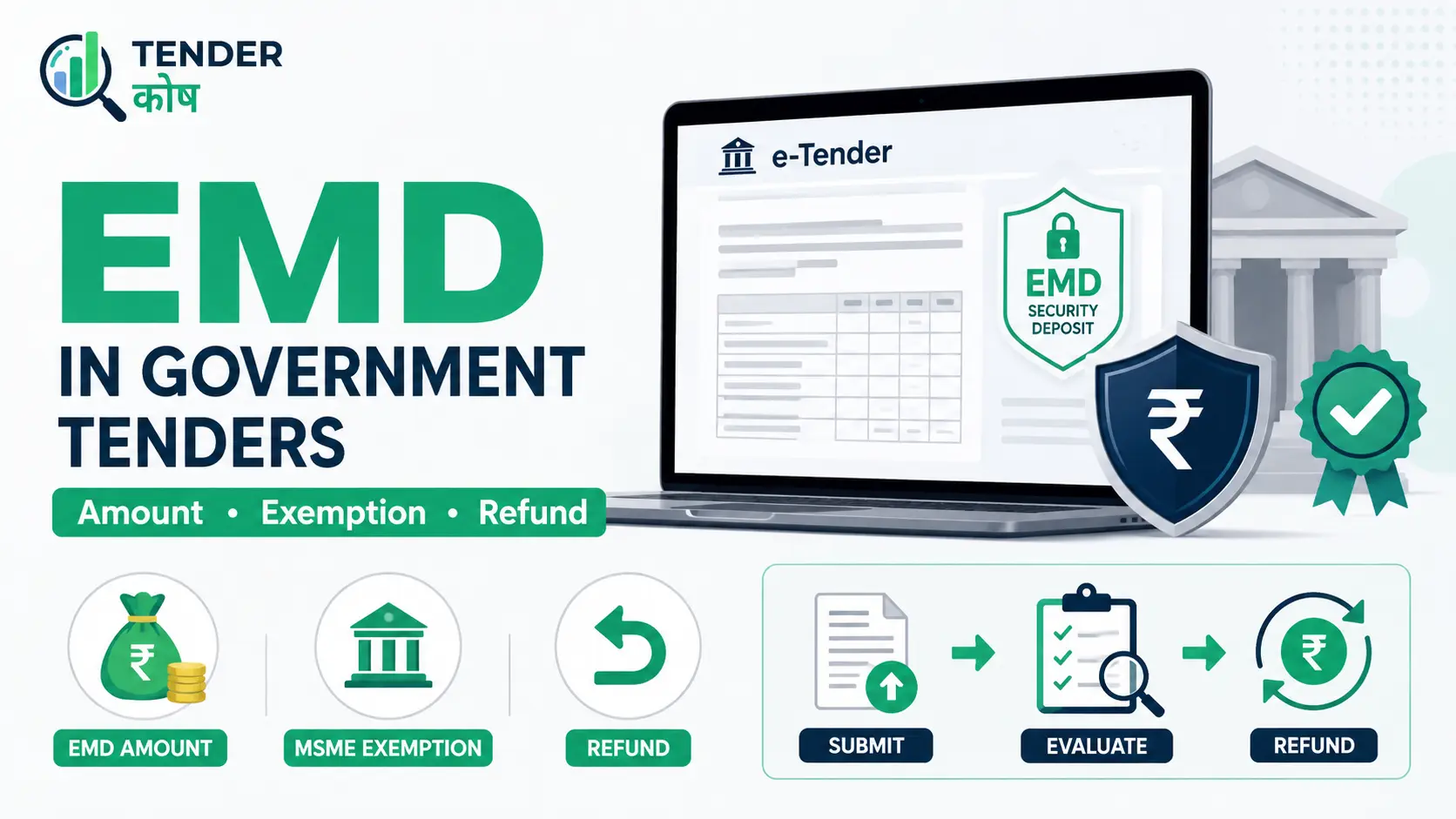
EMD (Earnest Money Deposit) in government tenders is a bid security submitted by a bidder to demonstrate commitment to the tender process. The amount, payment method, exemption rules and refund conditions depend on the specific tender.
Before submitting a bid, always check the tender document for the exact EMD amount, acceptable payment method, validity requirements and exemption conditions.
Get the EMD wrong and your bid can be rejected before technical evaluation even begins — a missing, short, or expired EMD is one of the most common avoidable disqualifications in government bidding. This guide explains what EMD is, why it’s required, how much is asked for, how to pay it, when MSMEs are exempt, and exactly when it is refunded or forfeited, followed by a pre-submission checklist you can run every time.
Key Takeaways
On this page
EMD, or Earnest Money Deposit, is a refundable bid security a bidder submits along with a tender to show genuine, serious intent to participate. It’s the financial equivalent of putting money on the table to prove you mean business.
EMD is a gatekeeper document: it is checked at the very start of evaluation, and a bid without valid EMD — or without a valid exemption or bid security declaration where permitted — can be treated as non-responsive and set aside before any technical or financial assessment. For central government tenders, the governing provision is Rule 170 (Bid Security) of the General Financial Rules (GFR) 2017.
Crucially, EMD is submitted with the bid and returned after the process. It should not be confused with performance security, which a successful bidder furnishes after winning, before signing the contract — a distinction covered in detail below.
EMD exists to keep the tender process serious and to protect the buyer from bidders who don’t intend to follow through. It does three jobs at once.
First, it deters frivolous bidding — a bidder who has to lodge real money is less likely to submit a casual or speculative bid. Second, it protects the procuring authority: if a successful bidder withdraws, refuses the award, or fails to sign the contract, the EMD can be forfeited to cover the disruption and cost of re-tendering. Third, it reinforces bid validity — because their money is at stake, bidders are motivated to keep their offers open for the required validity period.
In short, EMD aligns incentives: it filters out non-serious participants while giving the buyer a concrete remedy if a shortlisted bidder walks away.
There is no single, universal EMD figure — the amount is set in each individual tender document. The safest and only reliable approach is to read the exact figure from the specific tender rather than relying on a rule of thumb.
For central government tenders, EMD is governed by GFR 2017 Rule 170, and each tender states the required amount — typically as a fixed sum or a proportion of the estimated tender value. Some high-value tenders deliberately keep the percentage low so as not to discourage participation, while smaller works may state a flat amount. Different procuring authorities, PSUs, and state portals apply their own conditions on top of this.
Don’t assume a standard percentage. EMD requirements vary by procuring authority and tender. Always take the exact EMD amount, acceptable payment instrument, and validity period from the tender document itself rather than applying a generic percentage.
You rarely “calculate” EMD yourself — you read the required amount from the tender and make sure your instrument matches it exactly. Where the tender expresses EMD as a percentage of the estimated value, the arithmetic is simple, but the compliance details are what actually matter.
Confirm three things once you know the amount: that the figure on your instrument matches the tender exactly (a shortfall of even a small sum can invalidate it); that the instrument type is one the tender accepts; and that its validity extends far enough beyond your bid validity, since tenders usually require EMD validity to run a defined margin past the bid validity period. If evaluation runs long and the authority asks all bidders to extend bid validity, you must extend your EMD instrument to match — letting a bank guarantee quietly expire mid-evaluation is a common, avoidable disqualification.
EMD can be furnished through several instruments, and the tender specifies which ones it will accept. Using an instrument the tender doesn’t permit is as good as not paying at all.
| Instrument | Typical Use | What to Check |
|---|---|---|
| Bank Guarantee (BG) | Common for larger tenders | From an acceptable bank; validity extends the required margin beyond bid validity. |
| Fixed Deposit Receipt (FDR) | Pledged in favour of the procuring authority | Some departments specify particular banks; correct lien/pledge wording. |
| Demand Draft (DD) | Common for smaller-value tenders | Drawn in favour of the exact officer/authority named in the tender. |
| Online / NEFT / portal payment | Increasingly used on e-procurement portals and GeM | Complete payment in time; attach the generated reference to the bid. |
| Bid Security Declaration (BSD) | Where the tender permits it (often MSEs / many GeM tenders) | Signed on the prescribed format; no cash, but forfeiture-equivalent sanctions apply. |
Read the amount, instrument & validity in the tender.
Furnish EMD, or claim MSE exemption / file a BSD.
Attach EMD proof and submit before the deadline.
Refunded after the process, or forfeited on default.
Micro and Small Enterprises registered on the Udyam portal are generally exempt from furnishing EMD under GFR 2017 Rule 170 and the Public Procurement Policy for Micro and Small Enterprises — but the exemption is conditional, not automatic in every tender. This is one of the most valuable working-capital benefits available to small bidders.
DPIIT-recognised startups may receive similar EMD relief, and NSIC-registered units are also commonly recognised. However, eligibility depends on the applicable procurement policy and the specific tender’s conditions — for example, the tendered item may need to fall within the scope of the enterprise’s registration, and the bidder usually must upload valid proof (such as the Udyam Registration Certificate) and the required declaration with the bid. On GeM, exemption is often verified through the portal; on other portals you should not assume it will be applied automatically.
Where a tender offers it, the exemption is frequently operationalised through a Bid Security Declaration (BSD) — a signed undertaking accepted in place of a cash or bank-guarantee EMD. No money changes hands up front, but the bidder accepts that withdrawing during bid validity or failing to honour an award can lead to suspension or debarment from bidding with that buyer. In other words, exemption removes the cash outlay, not the underlying obligation.
Check the tender before assuming exemption. Not every tender waives EMD for MSEs, and conditions vary by procuring authority and portal. Confirm the exemption clause, keep your Udyam registration valid, and upload the exact proof and declaration the tender requires. For the wider set of small-business benefits, see our guide on MSME benefits in government tenders.
Track live tenders across GeM, CPPP, PSUs, and state portals in one dashboard — with EMD, exemption conditions, corrigenda, and submission deadlines in view before you bid.
EMD is a refundable security — it comes back to you once its purpose is served, provided you haven’t triggered a forfeiture condition. The exact timing is set by the tender and the procuring authority.
In general, unsuccessful bidders have their EMD released after the tender process concludes, and the successful bidder’s EMD is released after they furnish the required performance security and sign the contract. If a tender is cancelled or no valid bids are received, EMD is typically returned to all bidders. In practice, refunds can take longer than the norm stated in the tender, so it’s worth following up actively once the award is published.
EMD is forfeited when a bidder breaks the commitment the deposit was meant to guarantee. The specific grounds are listed in each tender, but the common ones are consistent.
Note that MSEs who bid under a Bid Security Declaration instead of cash EMD are not off the hook: defaulting still carries a real consequence — typically suspension or debarment from that buyer’s tenders — even though no deposit is forfeited.
EMD and performance security are different instruments at different stages — confusing them is a common beginner error. One secures your bid; the other secures your delivery of the contract.
| EMD (Bid Security) | Performance Security | |
|---|---|---|
| When submitted | With the bid | After winning, before signing the contract |
| Purpose | Secures the seriousness and validity of the bid | Secures proper performance of the contract |
| Who submits | All bidders (unless exempt) | The successful bidder only |
| Returned when | After the process / on furnishing performance security | After successful completion of the contract obligations |
Most EMD-related rejections come from avoidable slips, not from a genuine inability to furnish the security. These are the ones worth guarding against.
Run this quick checklist on the EMD before you submit — it takes minutes and prevents a rejection that no amount of technical or price strength can undo.
EMD (Earnest Money Deposit) is a bid security a bidder submits to demonstrate commitment to the tender process. It discourages frivolous bidding and protects the buyer if a successful bidder withdraws or fails to sign the contract. The amount, payment method, exemption rules, and refund conditions depend on the specific tender.
There is no single universal figure. The EMD amount is stated in each tender document, usually as a fixed sum or a proportion of the estimated value, and is governed for central tenders by GFR 2017 Rule 170. Always take the exact amount, payment method, and validity from the specific tender rather than assuming a standard percentage.
Micro and Small Enterprises registered on the Udyam portal are generally exempt from furnishing EMD under GFR 2017 Rule 170 and the Public Procurement Policy for MSEs, subject to conditions; DPIIT-recognised startups may receive similar benefits. Exemption is not automatic in every tender, so the specific tender’s conditions must be checked and the required proof and declaration uploaded.
A Bid Security Declaration is a signed undertaking accepted in place of a cash or bank-guarantee EMD where the tender offers it. No money is deposited up front; instead the bidder accepts being suspended or debarred from bidding with that buyer if they withdraw during bid validity or fail to honour an award.
EMD is generally refunded to unsuccessful bidders after the tender process concludes, and to the successful bidder after they furnish the performance security and sign the contract, as per the tender’s procedure. Exact timelines are set by the tender and the procuring authority.
EMD can be forfeited if a bidder withdraws or modifies its bid during the bid validity period, or if a successful bidder fails to accept the award, sign the contract, or furnish the required performance security, along with any other grounds specified in the tender.
EMD is a small step that carries an outsized power to sink a bid. The winning habit is simple: read the tender’s EMD clause carefully, match the amount, instrument, and validity exactly, claim any exemption you’re genuinely entitled to with the right documents, and re-check the latest corrigendum before you submit.
Do that consistently and EMD stops being a source of avoidable rejections — it becomes a routine box you tick with confidence on every tender.
Reference: EMD / bid security for central government tenders is governed by Rule 170 of the General Financial Rules (GFR) 2017, read with the Public Procurement Policy for Micro and Small Enterprises. Always treat the specific tender document as the authoritative source for the EMD amount, acceptable instruments, validity, exemption conditions, and refund/forfeiture terms. Central tenders are published on the Central Public Procurement Portal, eprocure.gov.in.
This article is general information, not advice. It has been compiled from publicly available sources — government releases and notifications, official portals, published tender documents and trade reporting — and reflects our understanding at the time of writing. It is not legal, financial, tax or professional advice, and it does not create any advisory relationship.
Public procurement changes constantly. Tender terms, eligibility criteria, thresholds, fees, deadlines, scheme conditions and government policy are revised frequently, often through corrigenda issued mid-window and sometimes without wide notice. Figures and rules that were accurate when published may already have changed by the time you read this.
Always verify against the primary source before you act or bid. The tender document, the issuing authority's official portal and the relevant government notification are the authoritative sources. Where anything in this article differs from them, the official source prevails. Do not rely on this page — or on any third-party summary — as the basis for a bid, an investment or a compliance decision.
TenderKosh is a private tender-intelligence platform. We are not a government body, and we are not affiliated with, endorsed by or acting on behalf of any government department, ministry, PSU or procurement portal. Names, marks and portals referenced belong to their respective owners and are used for identification only. External links are provided for convenience; we do not control and are not responsible for third-party content.
While we take reasonable care, we make no warranty as to the accuracy, completeness or currency of this content, and accept no liability for any loss or damage arising from reliance on it.Spotted something wrong or out of date? Please tell us at support@tenderkosh.com — we correct errors promptly.See our full Disclaimer.
Discover relevant tenders, monitor corrigenda, compare opportunities, and move from document reading to structured action.